
Unexpected metabolic complexity sustains early development
A critical phase of early embryo development is the implantation of the blastocyst into the uterine wall. A new study from Associate Professor Jan Żylicz’s research group at reNEW Copenhagen, led by Eleni Kafkia and David Pladevall-Morera, reveals that this transition is driven by far more complex metabolic changes than previously thought. Published recently in Cell Stem Cell, the work challenges the long-standing view that the embryo undergoes a simple metabolic switch, from oxygen-dependent metabolism toward increased reliance on glucose. Rather, the study shows that embryonic stem cells actively rewire their metabolism, directing nutrients through specific pathways to control gene expression and cell identity.
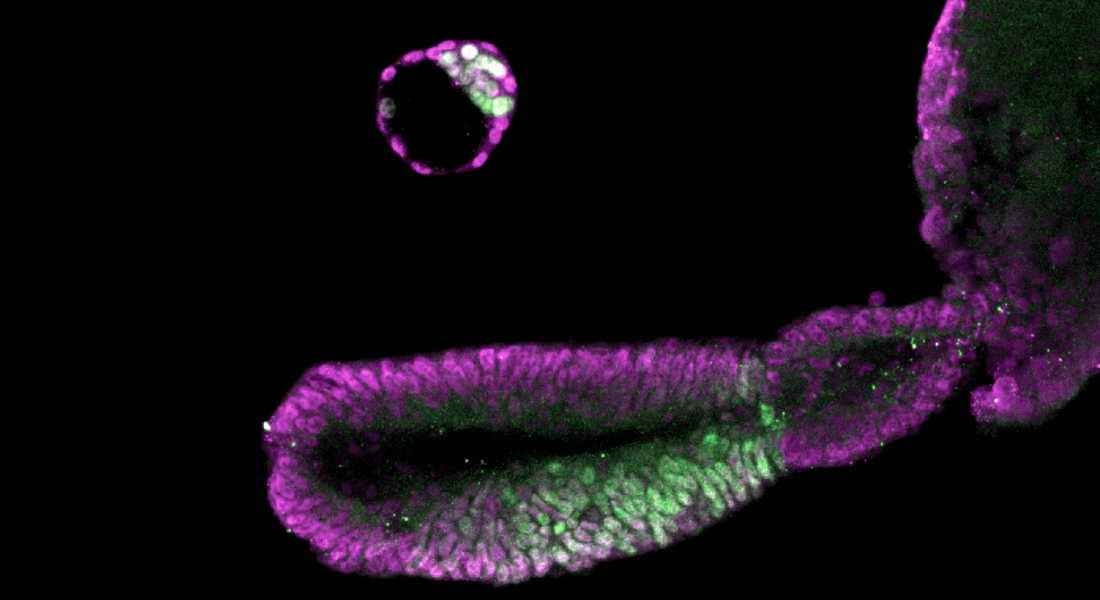
By studying both mouse embryos and stem cell models across this critical developmental window, the researchers have used advanced stable isotope tracing methods to follow how nutrients are processed within cells. They discovered that during implantation, the core metabolic pathway, called the TCA cycle, is rewired rather than shut down. Specifically, unexpected usage and production of pyruvate become essential for exiting the pre-implantation cell state and for enabling proper differentiation. Disrupting this so-called pyruvate cycling prevents normal developmental progression.
In the phase immediately following implantation, glutamine, the most abundant amino acid in the human body, was shown to increasingly fuel the TCA cycle. Strikingly, this extended beyond metabolism alone:
“We discovered that glutamine is the primary carbon source for the biosynthesis of acetyl-CoA used for histone acetylation, a fundamental epigenetic process that regulates gene expression and cellular identity. This contrasts with the established view that places glucose as the predominant nutrient for this modification,” explained Eleni Kafkia, Assistant Professor and co-first author of the scientific article.
The researchers further uncovered a remarkable crosstalk between metabolic pathways, where pyruvate metabolism supports a part of the TCA cycle running in reverse via the enzyme IDH1, to channel the carbon from glutamine into histone acetylation.
By performing experiments using stem cell models under oxygen conditions that closely resemble those of the uterine environment, and integrating these with mouse embryo data, the research team provides the most physiologically relevant map to date of metabolic activity in the early embryo during implantation.
“Interestingly, some of these pathways were previously thought to occur mainly in cancer cells or highly specialized tissues. This study shows that they are, in fact, a normal and essential part of early embryo development,” said David Pladevall-Morera, Dr. and the other co-first author of the scientific article.
The findings reveal a novel conceptual framework in which metabolic rewiring is tightly integrated with epigenetic regulation, reshaping our understanding of how metabolic states influence early embryo development and contribute to successful developmental progression.