
Studying appetite regulation in a dish
Obesity and related metabolic disorders are a rapidly expanding worldwide therapeutic challenge. A new study from Associate Professor Agnete Kirkeby’s research group at reNEW Copenhagen adds to the understanding of how the brain controls hunger and satiety. The work led by Zehra Abay-Nørgaard, Anika Mueller, and Erno Hänninen is published in Cell Stem Cell and presents a novel human stem cell-based model of the neurons that play a role in regulation of appetite and energy balance, thereby offering an unprecedented platform for studying obesity and potential new treatments.
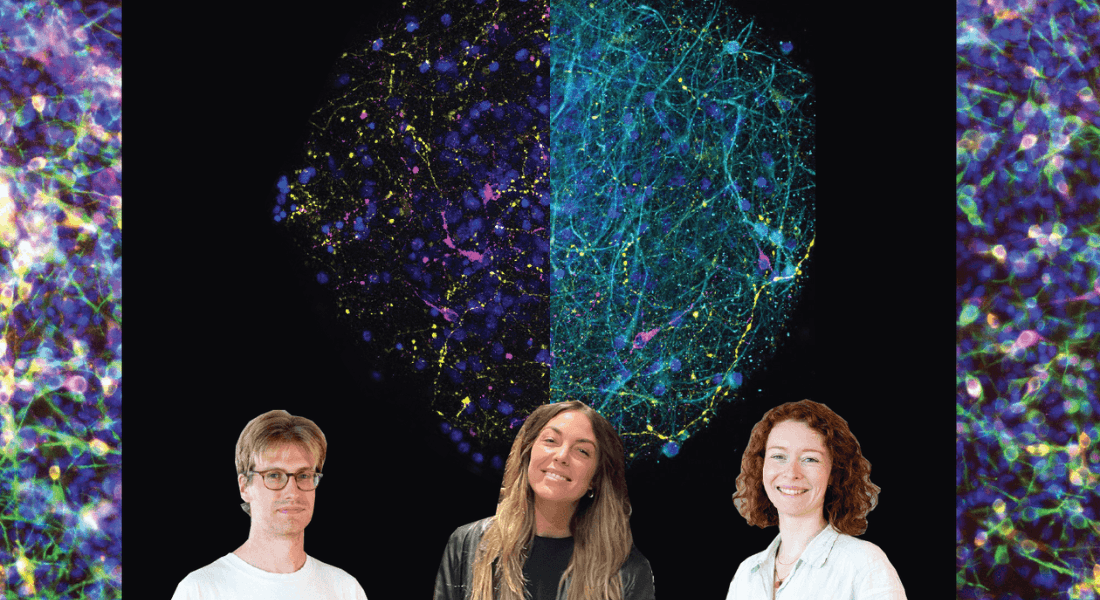
“This addresses a critical gap in the field by enabling direct investigation of appetite regulation at a cellular level in human brain cells. Until now, we’ve only been able to study appetite regulation in animal models such as the mouse,” says Associate Professor Agnete Kirkeby.
A small region of our brains, called the arcuate nucleus (ARC), functions as a crucial hub for controlling our sense of hunger and satiety in response to signals from the body. For instance, signals coming from the stomach, gut and adipose tissue – including the well-known GLP1 peptide – act on the ARC to influence our decision on whether to eat or not. However, the complex mechanisms involved in appetite regulation of this small brain area are still only poorly understood. The researchers have now successfully developed a novel technology to generate functional hunger-promoting and satiety-inducing ARC neuronal cell types in the dish from human pluripotent stem cells.
“This new in vitro stem cell-derived ARC model closely resembles the in vivo human ARC counterpart at the cellular level and exhibits key functional properties. The neurons secrete relevant peptides and respond to major appetite-regulating hormones. This confirms that the model is not only structurally accurate but also physiologically active, making it suitable for both mechanistic studies and drug screening applications,” explains PhD student Erno Hänninen.
A central discovery of the study is the identification of bone morphogenetic protein (BMP) signaling as a key regulator of ARC development. The precise timing and duration of BMP exposure determines the developmental outcome of the differentiating stem cells, controlling whether the stem cells produce the ARC region or neighboring brain regions.
The new model offers immediate practical applications, as the cells can be grown in scalable culture systems. Many more compounds can now easily be screened for their effects on human appetite-regulating neurons, an approach that is not feasible in animal models. The platform is already being adopted in collaborations with other academic groups and pharmaceutical companies to test drug candidates, investigate signaling pathways, and study the effects of genetic variation linked to obesity and metabolic disease.
“The project indeed highlights the value of combining stem cell biology, developmental neuroscience, and advanced genomics,” adds PhD student Anika Mueller. “We anticipate that this model will be a valuable resource for the field, enabling deeper exploration of how the human brain regulates appetite and metabolism.”
Read the article here.